
PNY GeForce RTX 5070 Ti Overclocked Triple Fan GPU Review
Going native at 4K/120Hz seems a solid goal for today’s gaming PCs, but the cost to get there might alarm those who’ve thus far been stuck with upscaling there $650 gaming consoles. PNY’s $940 RTX 5070 Ti Overclocked Triple Fan helps us build a complete PC that produces four times the pixels of those consoles…for only four times their price.
PNY GeForce RTX 5070 Ti Overclocked Triple Fan (VCG5070T16TFXPB1-O) | |
| Length | 300mm |
| Width | 120mm |
| Thickness | 60mm |
| Weight | 1237g |
| GPU O/C | 2295 MHz (+0%) |
| Boost O/C | 2572 MHz (+4.9%) |
Boxed Contents
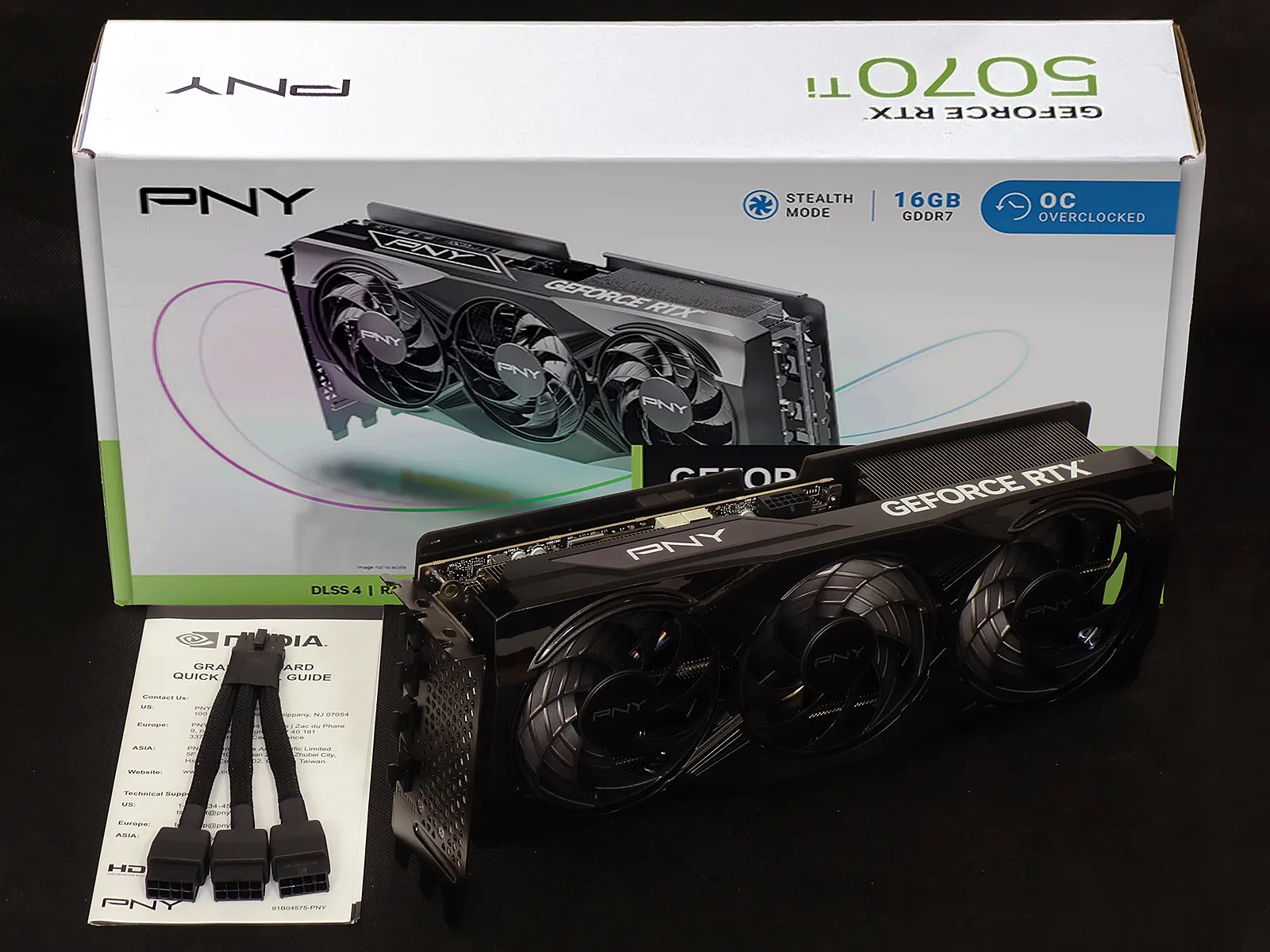
Inside the box we found a triple 8-pin PCIe to 12V-2×6 adapter that’s perfect for letting us keep our legacy power supply while we finish considering all of our options for replacement: PNY’s adapter requires all three inputs be powered, but that won’t be a problem for anyone who’s using a modern ATX 3.1 power unit.
Design Features
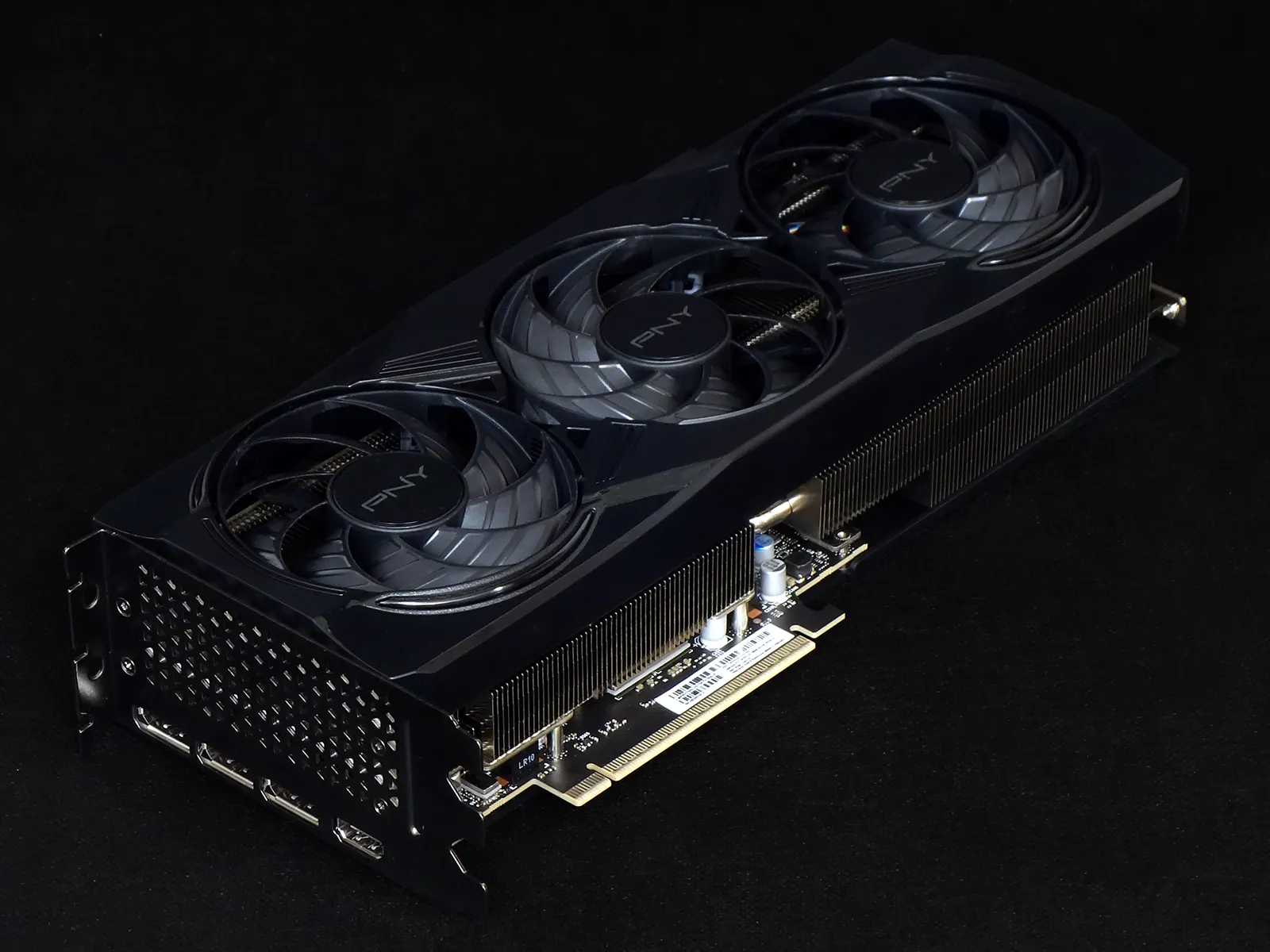
PNY’s GPU cooler uses counter-rotating fans (only the center fan spins clockwise) to improve its flow-to-noise ratio, but we were more surprised to find that the PNY logos are affixed to the fan’s frame rather than its blades as it would mean that the spindle is stationary.
Outputs include three DisplayPort and one HDMI.
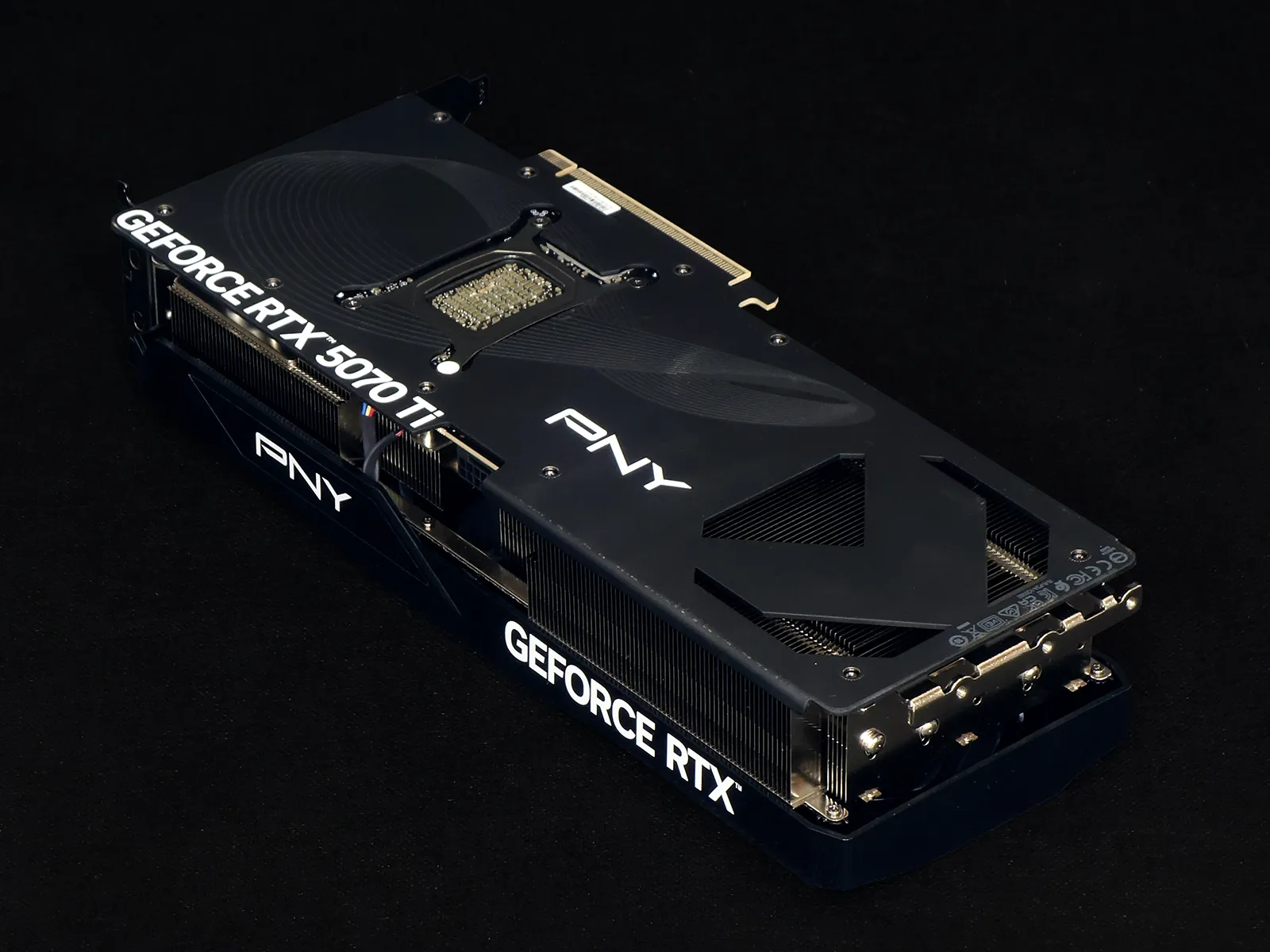
An aluminum brace that covers the back of the card is screen-printed with the PNY logo, the GeForce RTX 5070 Ti moniker and a wireframe rendering of a Möbius strip. As the assembly’s circuit board ends just past the cooler’s mid-point, that’s also where PNY placed its 12V-2×6 connector.
Nvidia doesn’t leave much room for overclocking at stock voltage, but PNY was a least able to give its version of the card a 4.89% boost increase (from 2452 MHz to 2572 MHz): That’s over eight times the paltry 0.6% increase claimed by Gigabyte’s 5060 OC.
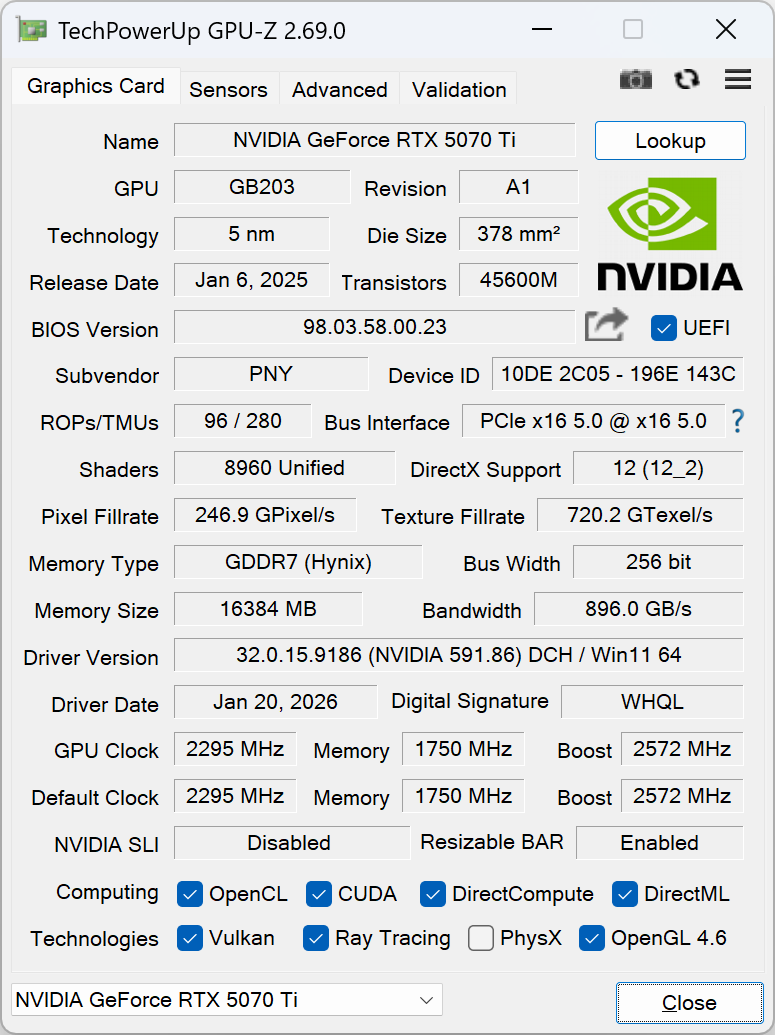
In fact, we’d love for you to compare the specs of PNY’s RTX 5070 Ti to the 4070 Ti it replaces: We’ve stuck all our other compared cards in the space between, where they’ll help us access or minimum requirements as well as our best-value picks.
| PNY RTX5070Ti 16GB TRPLFAN OC | Gigabyte RTX5060 WindForce OC 8G | Phantom Gaming RX7700XT PG 12GO | PowerColor Red Devil RX 6750 XT 12GB | PNY GeForce RTX Verto 4070 Ti 12GB | |
| GPU | GB203 | GB206 | Navi 32 | Navi 22 | AD104 |
| ROPs/TMUs | 96 / 280 | 48 / 120 | 96 / 216 | 64 / 160 | 80 / 240 |
| Shaders | 8960 Unified | 7680 Unified | 3456 Unified | 2560 Unified | 7680 Unified |
| Pixel Fillrate | 246.9 GPixel/s | 120.6 GPixel/s | 249.5 GPixel/s | 167.9 GPexil/s | 208.8 GPixel/s |
| Texel Fillrate | 720.2 GTexel/s | 301.4 GTexel/s | 561.4 GTexel/s | 419.7 GTexel/s | 626.4 GTexel/s |
| Memory Size | 16GB GDDR7 | 8GB GDDR7 | 12GB GDDR6 | 12GB GDDR6 | 12GB GDDR6 |
| Memory Bus | 256 bits | 128 bits | 192 bits | 192 bits | 192 bits |
| Bandwidth | 896 GB/s | 448 GB/s | 432 GB/s | 432 GB/s | 504.2 GB/s |
| GPU Clock | 2295 MHz | 2280 MHz | 2276 MHz | 2553 MHz | 2310 MHz |
| Boost Clock | 2572 MHz | 2512 MHz | 2599 MHz | 2623 MHz | 2610 MHz |
| Memory Clock | 1750 MHz | 1750 MHz | 2250 MHz | 2250 MHz | 1313 MHz |
And here’s the humble machine that we’ll be using to benchmark these stellar graphics cards:
| Test Hardware | |
| CPU | AMD Ryzen 9 7950X: 16C/32T 4.5-5.7 GHz, 64MB L3 Cache, Socket AM5 |
| CPU Cooler | Alphacool Core 1 Aurora, Eisbecher D5 150mm, NexXxoS UT60 X-Flow 240mm |
| DRAM | Crucial Pro OC Gaming Edition DDR5-6400 32GB at DDR5-6000 EXPO |
| Hard Drive | Crucial T700 2TB PCIe 5.0 M.2 SSD |
| Power | be quiet! Dark Power Pro 10 850W: ATX12V v2.3, EPS12V, 80 PLUS Platinum |
| Graphics Driver | GeForce 591.86 (2026/01/20) |
| AMD Graphics Driver | AMD Adrenalin Edition 24.3.1 |
We’re using shortened name “RTX5070Ti 16GB TRPLFAN OC” that appeared on this card’s wrapper to save space in today’s charts.
Benchmark Results
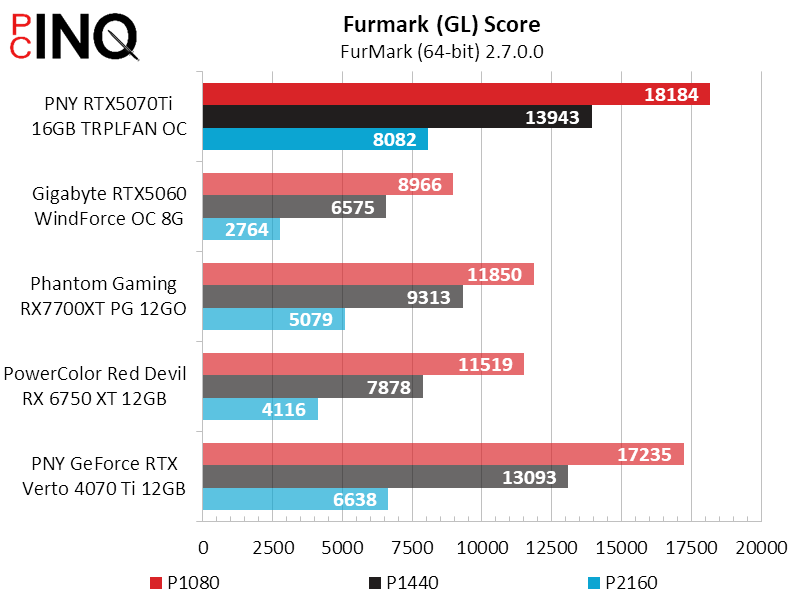
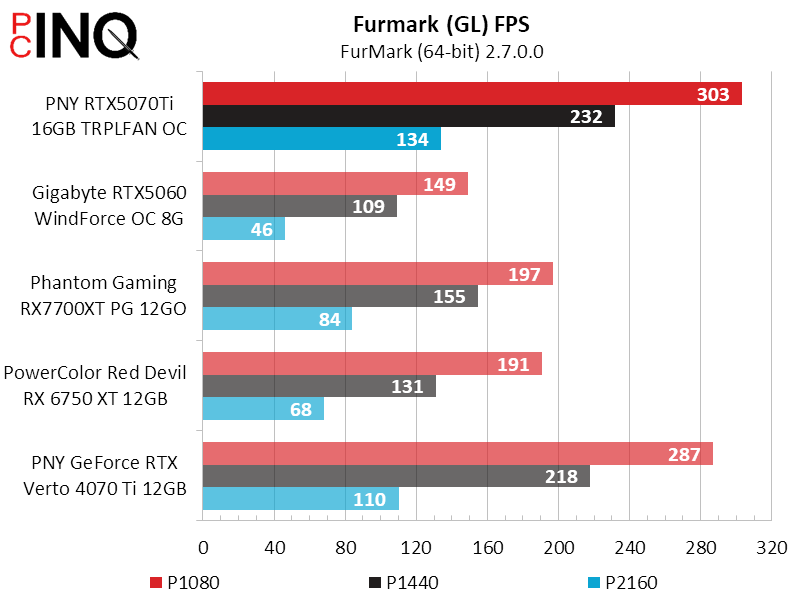
Furmark shows the 5070 Ti barely outpacing the 4070 Ti (5.6%) at 1920×1080, but the gain is far more pronounced (21.8%) at 3840×2160. We’ve heard that much of that difference is due to the need of some programs for 16GB of local memory to properly run 4k.
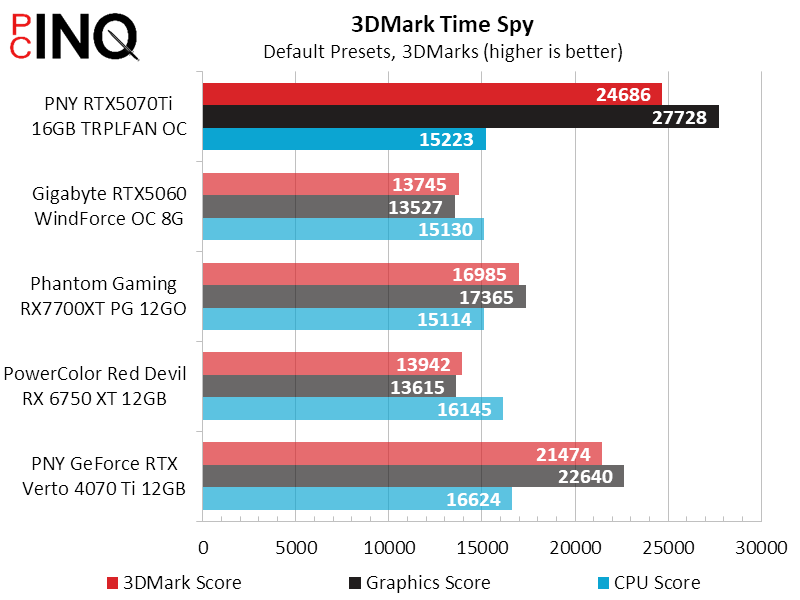
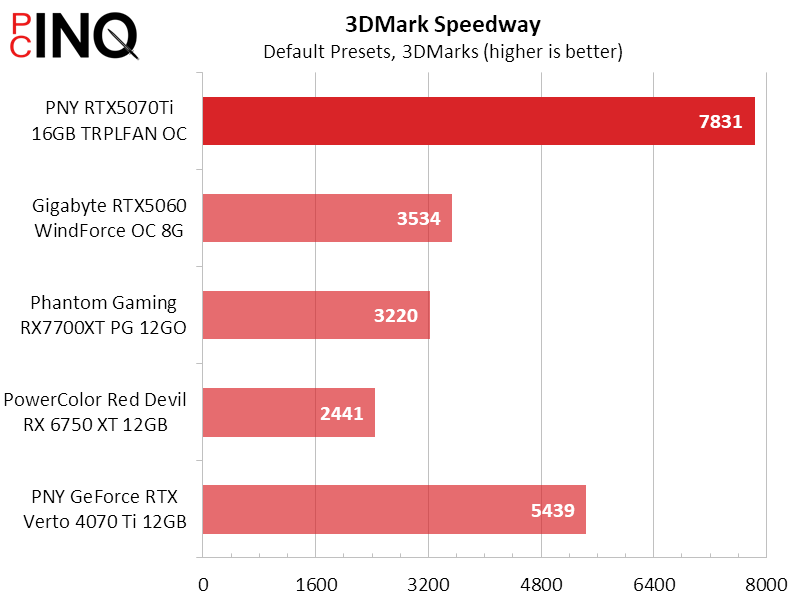
The old 3DMark Time Spy test was fairly good test for midrange cards when introduced a decade ago, but its relavence now is merely numeric: It shows that the 5070 Ti is 22.5% better than the 4070 Ti. Speedway is a little more relevant as the card’s 7831 score relates to a 78.31 average FPS.
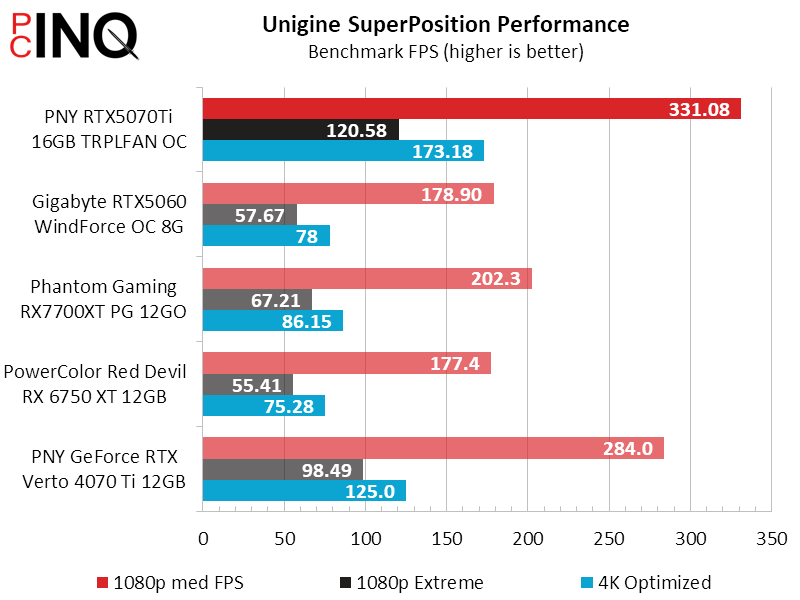
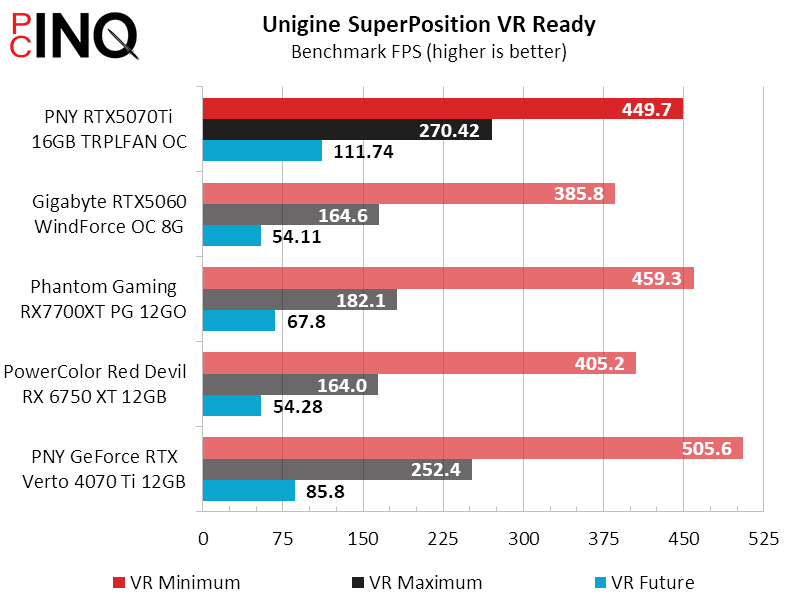
Almost entirely GPU constrained when used on a modern system, SuperPosition benchmark shows optimized 4K results as less GPU-intense than 1080p Extreme. Moreover, that 1080p Extreme setting is as far as we can push the card if we’re to maintain an average FPS of 120, where as the 4070 Ti couldn’t even get past 100 FPS in this test.
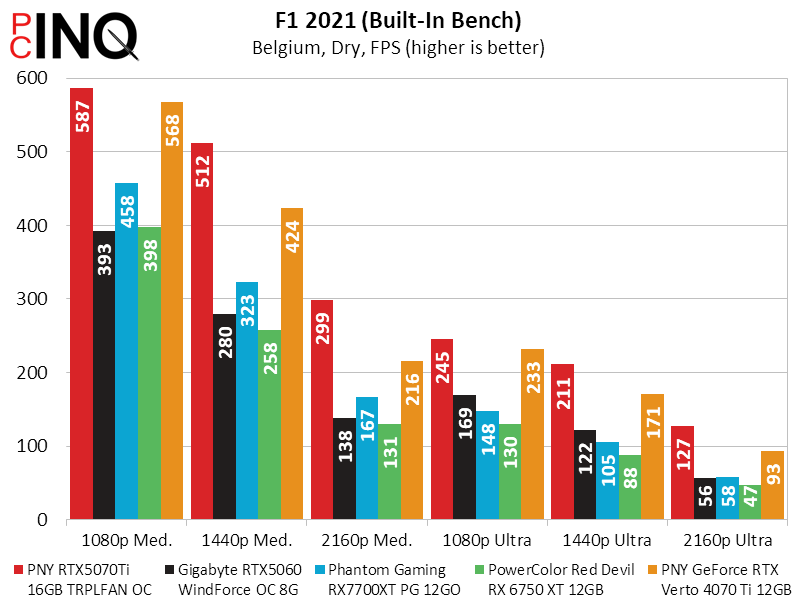
As we peer into real game performance, we see the 5070 Ti averaging 127 FPS where the 4070 Ti couldn’t even reach 100. As lesser cards struggled to get close to the old 60 FPS standard, users of those models could be forced to choose between lowering their resolution or lowering their detail levels.
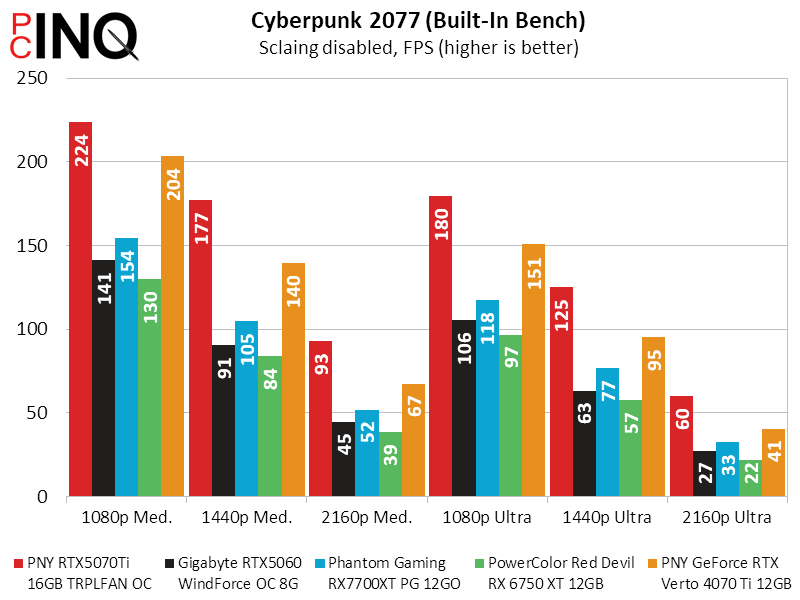
Cyberpunk 2077 enables GPU scaling whenever you choose a preset level, so that testing at native resolution requires manually disabling it whenever we toggle between Medium and Ultra quality. Native FPS shows why the game is pushing us to take it easy on our hardware, as the 5070 Ti’s native resolution settings couldn’t average 120 FPS even at Medium detail. And the others? The runner-up 4070 Ti only got to 67 FPS, so that PC users are stuck using the same tricks as consoles deploy just to fake 4k at 120Hz.
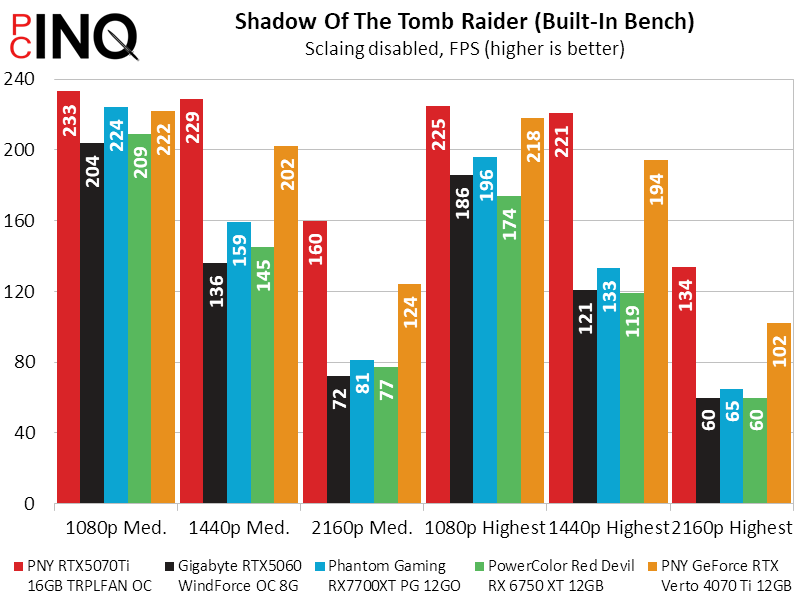
On the other hand, if you like Shado Of The Tomb Raider, you can easily use 4k at 120Hz with the 5070 Ti, and nothing less.
Power, Heat & Efficiency
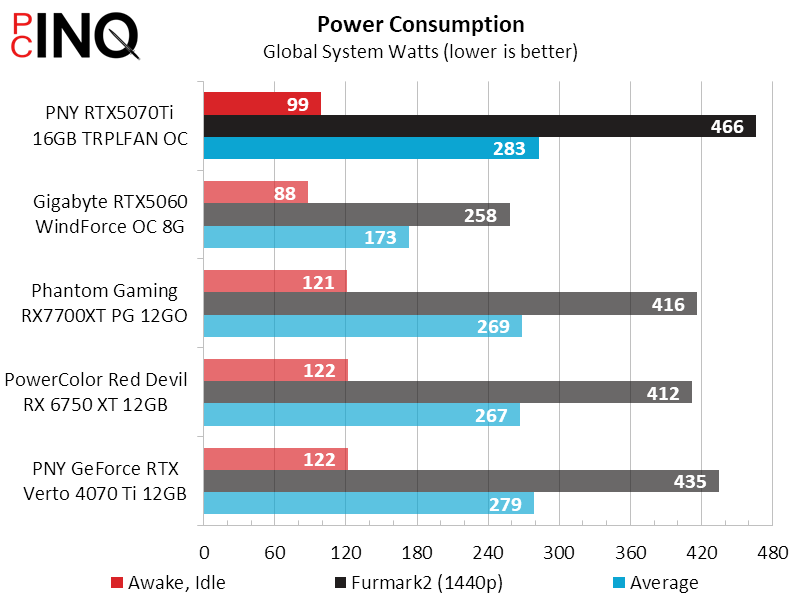
So the RTX 5070 Ti consumed much less power at idle than the other cards? Well, it also consumed much more power under load, to the point that the average between these two is higher than all the other cards.
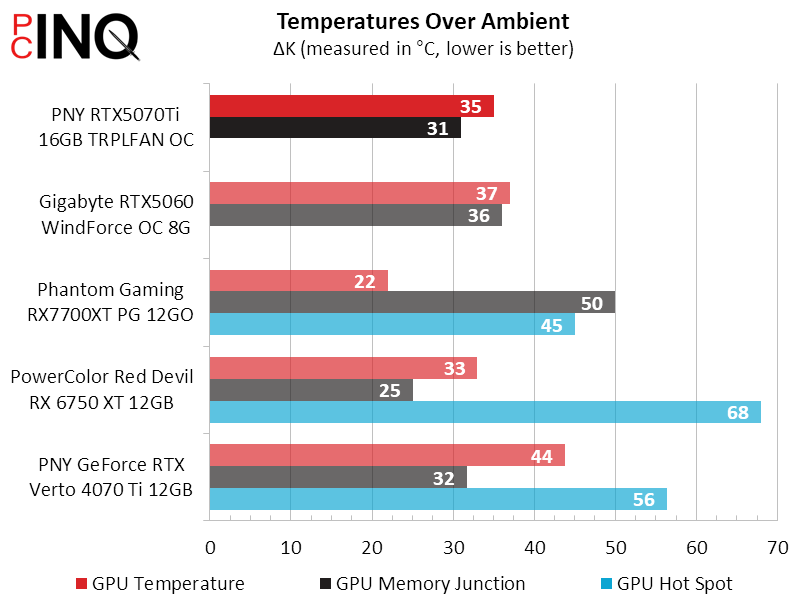
Those high wattage readings certainly weren’t due to any overheating, as the 5070 Ti ran cooler than the 4070 Ti in Furmark, which is about the toughest test we can throw at it. Note that we do our thermal tests at full component fan speed: This is the first time we heard the card over our test system’s fans.
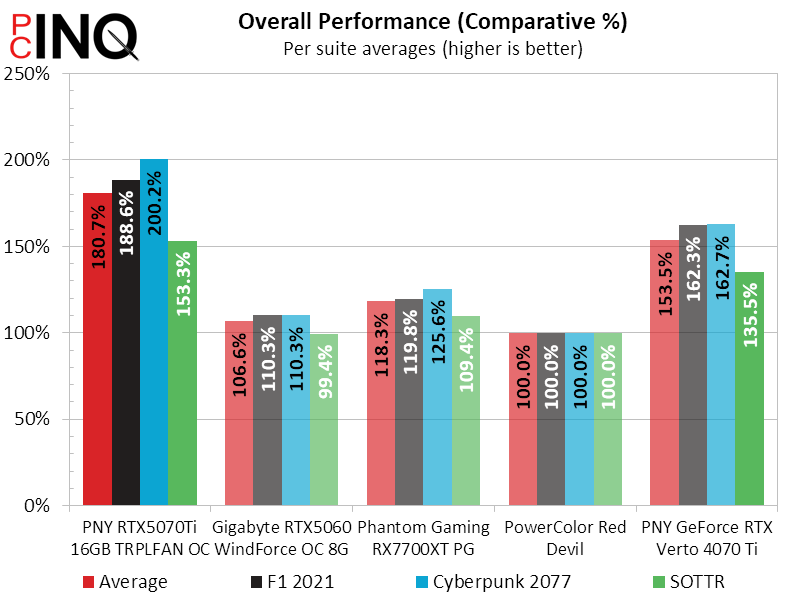
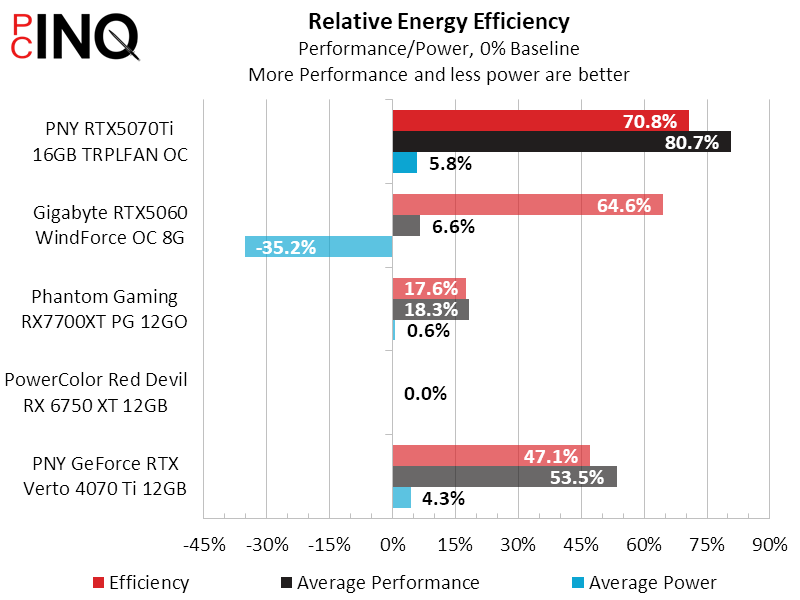
Since we started this series of reviews with the Red Devil RX 6750 XT, it becomes the baseline for comparing performance gained. The RTX 5070 Ti is 53% to 100% faster, while the 4070 Ti was only 36% to 54% faster than the older Radeon.
PNY’s RTX 5070 Ti performed so well that it even produced 71% more frames per watt than the RX 6750 XT!
Final Value Verdict
The one problem of using our oldest card for reference numbers is that its price quit falling a couple years ago. The value penalty normally associated with high-end hardware is only pronounced when we compare it to the RTX 5060 which, despite its relatively low raw frame rate, produces roughly 50% more frames for every dollar spent.
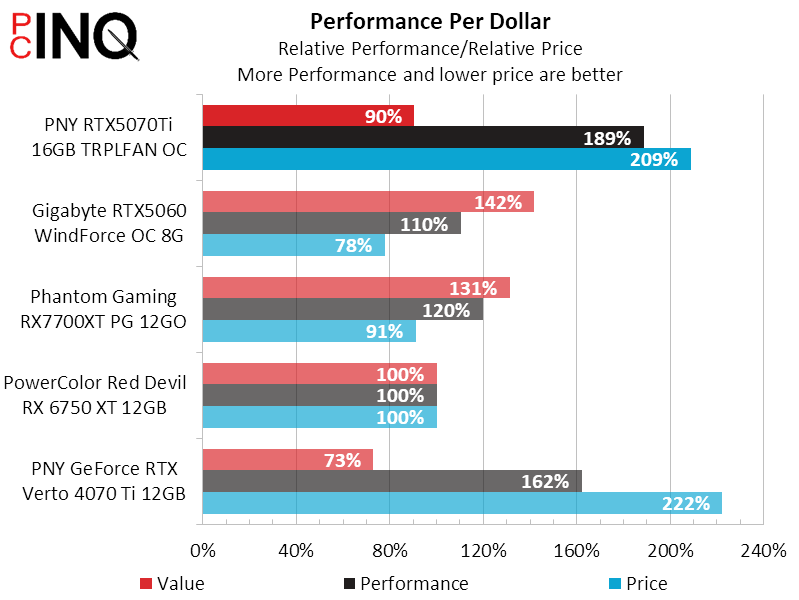
We all understand that the RTX 5060 only got the high value score by producing roughly 60% the performance for roughly 40% the price, and that it will never be a true 4K/120Hz solution. For that you’ll need the 5070 Ti. And even then, you’ll have to resort to the same tricks as game consoles use to get those settings to work under Cyberpunk 2077.
| PNY GeForce RTX 5070 Ti Overclocked Triple Fan GPU (VCG5070T16TFXPB1-O) | |
| Pros | Cons |
| Native 4k/120Hz and high settings in most games | Still can’t do 4k/120Hz in Cyberpunk 2077 Most users can’t afford a $1000 card. |
| The Verdict | |
| PNY’s version of the RTX 5070 Ti does not disappoint, but paying nearly a grand for a Tier 3 (behind 5090 and 5080) card is a tough task for builders. | |
Find it at Amazon
(click for availability)


